On Montessori Education
This is me when I turned three.
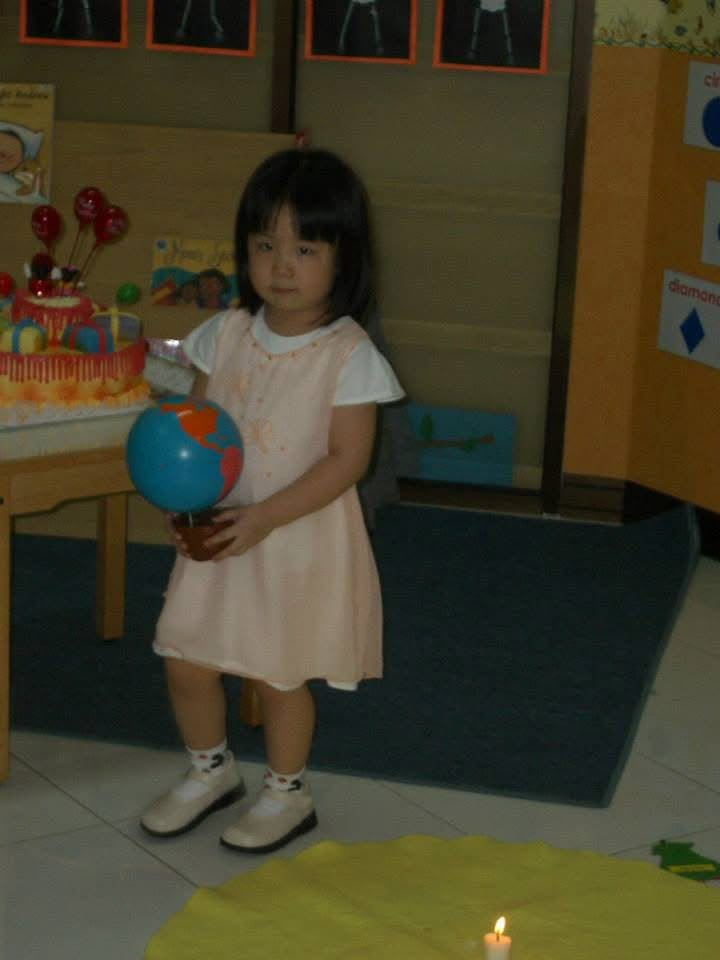
At Kiddie Planet, the Montessori school I attended, birthdays were celebrated by holding a globe and circling around the ‘Sun’ (which was a circular yellow felt mat with a candle in the center) the same number of times as our age.
I didn’t know it at the time, but this might have been an example of a Montessori principle highlighted in Dr. Angeline Lillard's (2005) book, Montessori: The Science Behind the Genius: embedding movement during learning. Research has shown that movement can facilitate learning (e.g., self-performed tasks are remembered better; Engelkamp et al., 1994).
In the book, Dr. Lillard breaks down eight core Montessori principles and the research supporting them. Here are my TL;DRs for each!
- Movement: We learn better when movement is meaningfully integrated into learning. Thus, Montessori materials and classrooms often have movement embedded within them.
- Choice: Allowing a child choice and perceived control within a structured environment is conducive to learning. Unlike traditional schools with fixed schedules, Montessori children get to choose what set of materials they get to work on.
- Interest: Developed through decades of observation, Montessori believed that her materials were inherently interesting to children. Interest can also be stimulated by building upon prior knowledge. Research has indeed shown that prior knowledge is beneficial to learning (e.g., Thompson & Zamboanga, 2003).
- Minimize extrinsic rewards: Lepper et al. (1982) suggest that when an activity is framed as a means to an end, people may come to devalue the first activity and overvalue the second. If children learn just to get a good grade, what happens to learning for the love of learning? Montessori lessons rarely assign grades, and the materials often have built-in error control, or children can refer to a sample and self-correct.
- Peer learning: Children can learn from and with their peers, which is one reason Montessori has mixed-age classrooms. After all, in real life, we also work with people of different ages.
- Meaning: Closely related to principle 3, children learn better when materials are situated within meaningful contexts. An interesting study brought up was a modification of Piaget's Three Mountains Task. Borke (1975) found that children performed better on perspective-taking tasks when the materials and scenarios were more familiar.
- Adult interaction: Teachers should foster secure relationships with children and be mindful of their use of praise (see principle 4, as praise can become a form of extrinsic reward). When children seek praise, however, feedback can focus on their strategies rather than fixed traits (e.g., “You put a lot of effort into this work” vs. “You are smart”).
- Order: Montessori children have to clean up after themselves, and each material has a specific sequence for how to use it. Research has shown that spatial organization can facilitate memory, reminding me of the method of loci (i.e., mentally placing objects in familiar locations, such as different rooms in your house, can improve recall; Twomey & Kroneisen, 2021).
Now that I'm doing a PhD in Psychology, more specifically in Learning Sciences, it feels quite full circle to learn more about an educational approach I experienced as a child but wasn't really aware of the potential science behind it.
Perhaps one of my biggest takeaways from this book is that children are not ‘empty vessels’ waiting to be filled with knowledge, but active doers and agents in their own learning; that the education Dr. Montessori advocated for is an environment where children are empowered to learn and love learning.
I asked my mom what differences she noticed in me after I attended Montessori, and she said I grew a lot braver. Of course, I'm a sample size of one and can't fully attribute that to Montessori, but looking back at that little girl holding a globe and walking around the sun, it's quite nice to think that, more than two decades later, I'm learning about the science behind what she was doing!
Anyways, this is me when I turned twenty-five.

Didn't walk around the sun 25 times though… I would've gotten dizzy.
References
- Borke, H. (1975). Piaget's mountains revisited: Changes in the egocentric landscape. Developmental Psychology, 11(2), 240–243. https://doi.org/10.1037/h0076459
- Engelkamp, J., Zimmer, H. D., Mohr, G., & Sellen, O. (1994). Memory of self-performed tasks: Self-performing during recognition. Memory & Cognition, 22(1), 34–39. https://doi.org/10.3758/BF03202759
- Lepper, M. R., Sagotsky, G., Dafoe, J. L., & Greene, D. (1982). Consequences of superfluous social constraints: Effects on young children's social inferences and subsequent intrinsic interest. Journal of Personality and Social Psychology, 42(1), 51–65. https://doi.org/10.1037/0022-3514.42.1.51
- Lillard, A. S. (2005). Montessori: The science behind the genius. Oxford University Press.
- Thompson, R. A., & Zamboanga, B. L. (2003). Prior knowledge and its relevance to student achievement in introduction to psychology. Teaching of Psychology, 30(2), 96–101. https://doi.org/10.1207/S15328023TOP3002_02
- Twomey, C., & Kroneisen, M. (2021). The effectiveness of the loci method as a mnemonic device: Meta-analysis. Quarterly Journal of Experimental Psychology, 74(8), 1317–1326. https://doi.org/10.1177/1747021821993457